
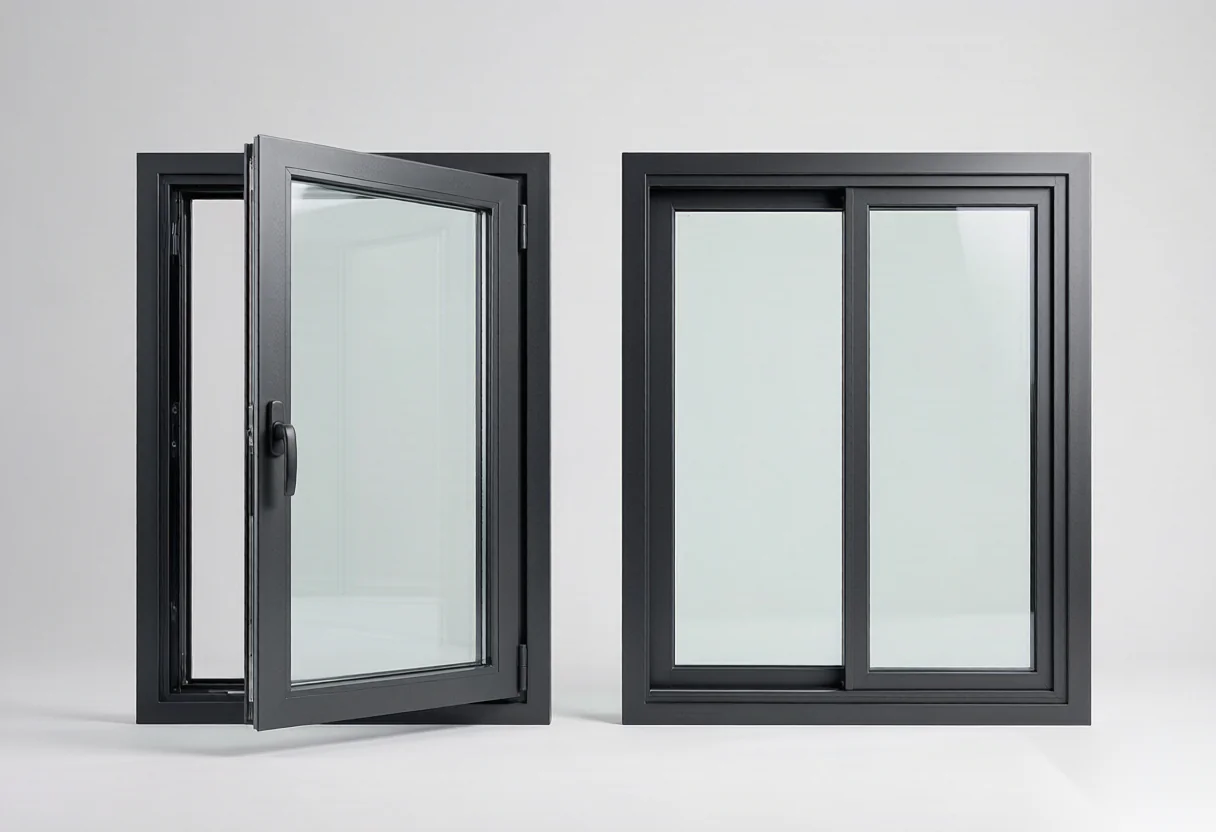
What Are Casement Aluminum Windows?
Casement windows are hinged on one side and swing open like a door — outward for most European and US specifications, or inward where local codes require. Because the sash closes firmly against the frame with multi-point locking, a casement aluminum window delivers the highest air and water tightness of any operable window type. Paired with a thermal-break profile, it reaches the low U-values required by EU energy regulations and passive-house projects.
What Are Sliding Aluminum Windows?
Sliding windows glide horizontally along a track, with one or more panels moving past a fixed pane. They need no clearance outside the wall, which makes the sliding aluminum window the default choice for balconies, tight elevations and high-rise apartments where an outward swing is impractical or prohibited. Operation is simple and light, ideal for elderly users and large-format glazing.
Casement vs Sliding Windows: Side-by-Side
| Feature | Casement Window | Sliding Window |
|---|---|---|
| Opening style | Side-hinged, swings fully open | Horizontal track glide |
| Air tightness | Excellent (multi-point seal) | Moderate (track gaps) |
| Ventilation | Up to 100% of opening | Max ~50% of width |
| Energy efficiency | Best (low U-value possible) | Good, slightly higher loss |
| Space needed | Clearance outside/inside | None beyond the wall |
| Cleaning | Easy with tilt & turn | Track can collect debris |
| Acoustic performance | Superior | Good |
| Hardware cost | Higher (hinges, locks) | Lower (rollers, rail) |
| Best for | Villas, passive houses, cold climates | Balconies, apartments, warm climates |
Air Tightness and Energy Efficiency
If your project must meet CE or NFRC performance targets, casement windows win on sealing. The compression gasket around a closed casement sash stops drafts that sliding tracks cannot fully eliminate. For heating-dominated markets (Northern Europe, US Midwest) this translates into measurable heating-cost savings and condensation control.
Ventilation and Daylight
A casement sash opens completely, catching side breezes and exhausting warm air efficiently. A sliding window can only ever open half its width, capping airflow. On the other hand, sliding systems keep the full glass area visible when closed and suffer no obstruction from an open sash — a plus for uninterrupted views.
Space, Aesthetics and Cleaning
Casement windows need swing clearance, which can clash with walkways, shutters or adjacent units. Sliding windows sit flush and save space. For maintenance, tilt & turn casement hardware lets the sash rotate inward for safe interior cleaning; sliding tracks need periodic debris removal to keep rollers smooth.
Cost and Lead Time
Sliding windows use simpler hardware (rollers and rail) and are generally the lower-cost option per square meter. Casement systems carry higher-spec hinges and multi-point locks, but the performance gap justifies the premium on premium residential and commercial work. Both are produced on LEXIA’s standard 35-day export line.
Which Window Should You Choose?
- Villa / detached home: casement or tilt & turn for sealing and quiet.
- Passive-house / cold climate: casement with thermal-break profile.
- High-rise apartment: sliding or tilt & turn (outward swing restricted).
- Balcony / patio: sliding for space-saving operation.
- Warm-climate renovation: either — sliding for budget, casement for efficiency.
Source Aluminum Windows from LEXIA
LEXIA manufactures both casement and sliding aluminum window systems with CE / NFRC ratings, RAL color customization and OEM/ODM support for global distributors. Request a quote with your profile, opening type, size and quantity — our technical team replies within 24 hours.